The Engine That Gave Us Time
In the previous article, we talked about professions and how artificial intelligence may change them.
But I believe none of those changes are the real story. The real story is much bigger.
To explain what I mean, let's go back almost two hundred years.
When people talk about the internal combustion engine, they usually think about cars. And they are right.
Later, engineers like Gottlieb Daimler and Carl Benz turned the internal combustion engine into practical vehicles that changed the world forever.
But I don't think cars were the biggest invention. I don't even think transportation was. To say, yes, it was an achievement. But I mean not that made it revolutionary (aka, that we can have cars)
I believe something much more important happened. Something we rarely notice because it happened so gradually. The engine didn't simply help people travel faster.
It gave humanity time.
The Most Valuable Gift
Think about how people lived before machines. For thousands of years, most of life was about survival. Growing food. Transporting goods. Building homes.
Everything depended on human or animal effort. Then machines slowly started doing part of that work. One machine replaced the work of several people. Another made transport much faster. Factories became more productive. Farms became more efficient.
Little by little, humanity received something it had never had before on such a scale.
More time.
Maybe people living at that time didn't think about it this way. They simply accepted each new invention and moved on.
But today, looking back, I think we can clearly see what really happened. The engine didn't only create industries. It created opportunities.
People no longer had to spend their whole lives working the fields.
They became engineers, teachers, scientists, doctors, artists and, much later, software developers.
Entire professions became possible because fewer people were needed simply to produce food.
For me, that was the real revolution. Not horsepower. Not engines.
Time.
And this is exactly why I believe artificial intelligence is much more important than most people realise.
Many people focus on what AI can do today. Write code. Generate images. Answer questions. Those are impressive demonstrations. But I don't think they are the real story.
AI may become the next invention that gives humanity more time.
The World Is Accelerating
Sometimes I ask myself a very simple question. Is the world really changing faster, or does it only feel that way because I am living through it? To be honest, I don't know.
But when I look back at history, I have the feeling that every major breakthrough arrives sooner than the previous one. For thousands of years, progress was relatively slow. Then came the industrial revolution, electricity, computers, the Internet and now artificial intelligence.
Maybe history isn't really accelerating. Maybe it only looks that way from where I stand today. But this is honestly how I see it.
It feels as if humanity has started running instead of walking.
I can already see this in my own work. Artificial intelligence allows me to do things that only a few years ago would have taken much longer. It doesn't replace me, and it still makes mistakes, but one thing is impossible for me to ignore.
It increases my productivity.
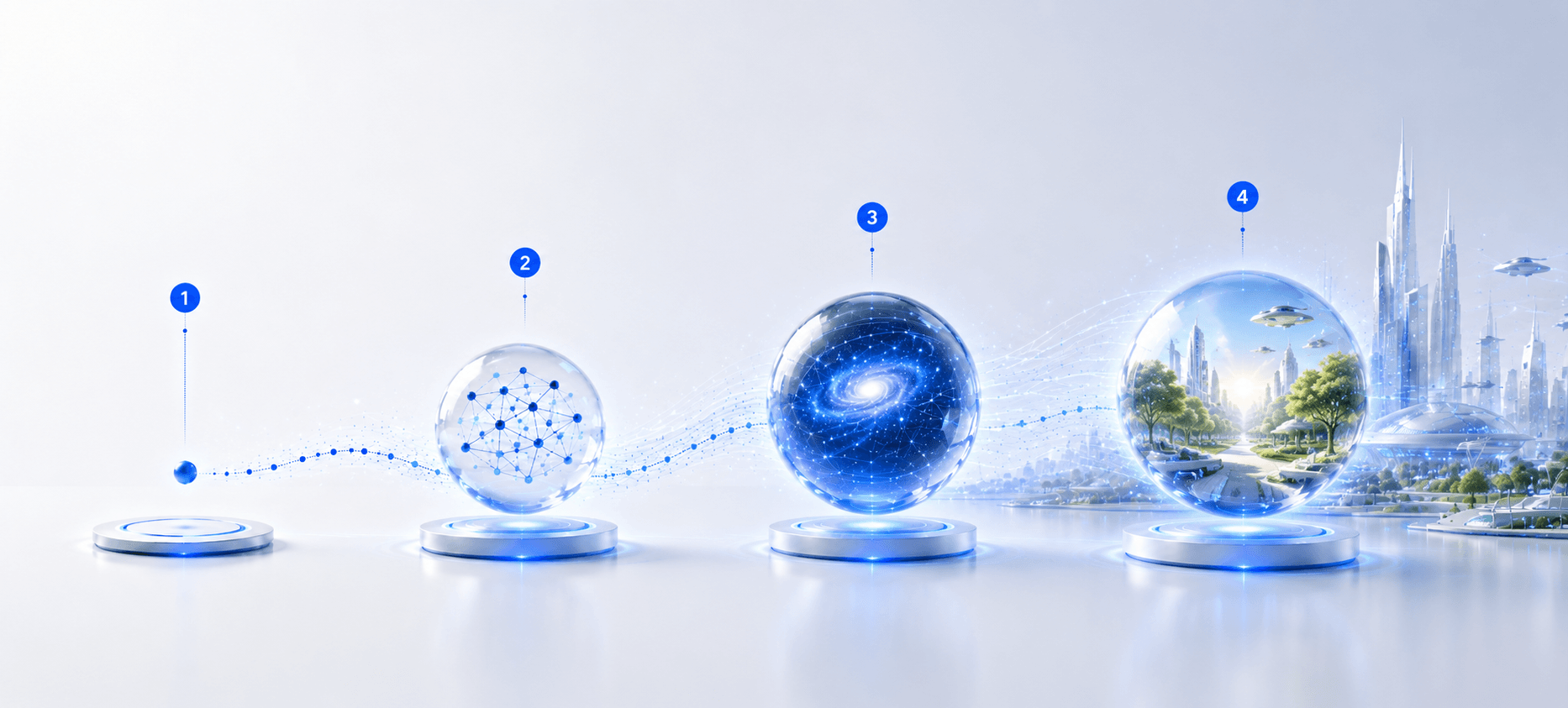
If I can already feel that change today, I can only imagine what may happen in one hundred years. Or five hundred. That is exactly why I started thinking about the fourth point.
Not because I believe I know the future.
Because I believe the direction is already visible.
Travel Without Limits
Let's look at another example. Imagine I asked you a very simple question.
What would you do if money were no longer a problem?
I think many people would answer the same way.
I would travel.
Why? Because travelling is still expensive. Transportation costs money. Hotels cost money. Food costs money. Almost every part of the journey depends on how much you can afford.
Now imagine the world we have been discussing throughout this series. Cars become much cheaper to produce. Buildings are constructed mostly by robots. Hotels are assembled much faster than today. Food production and restaurants become highly automated.
If producing almost everything becomes cheaper, then travelling also becomes cheaper. Maybe one day it won't even be considered a luxury. It will simply become another part of everyday life.
That doesn't mean everyone suddenly moves to Paris.
Actually, I don't think that would happen.
People are different. Some love the mountains, others the sea. Some enjoy busy cities, while others prefer quiet villages. Technology doesn't change our personalities.
It simply gives us more freedom to choose.
Freedom is another form of time.
When you don't spend your life worrying about everyday survival, you finally have the opportunity to decide how you want to live. For me, this is one of the biggest promises of artificial intelligence.
A Different Society
At this point another question naturally appears. If people have more time, more freedom and machines do most of the everyday work, what kind of society do we become?
This is probably the hardest question in the entire series. I don't claim to know the answer. I'm simply trying to imagine where this road may lead.
Personally, I believe we slowly move towards a world where work is no longer the centre of life. Today we often introduce ourselves through our profession. We say, "I'm a programmer," "I'm a doctor," or "I'm a lawyer."
Maybe one day that won't be the first thing we say about ourselves.
Maybe people will be known for what they create, not for the job they have.
I believe work will slowly stop being something we must do in order to survive. Instead, it may become something we choose because we genuinely enjoy it.
Some people love designing cars. Others enjoy teaching. Some love writing music, while others want to build robots or paint pictures. I don't think artificial intelligence removes those passions.
Actually, I believe it does the opposite.
It gives more people the chance to discover who they really are.
Give someone complete freedom for a week, and they will probably rest. Give them complete freedom for a year, and sooner or later they will start creating something.
That is simply human nature. We like learning. We like improving. We like building things. Sometimes we just don't have enough time.
Maybe that is the biggest gift technology has ever given us.
And maybe artificial intelligence will become the next step in exactly the same direction.
Will Money Always Matter?
From this point, another question naturally appears.
Money.
I know this is probably one of the most controversial parts of my prediction. Many people will disagree with me, and that is perfectly fine. I'm simply sharing where I think this road may eventually lead.
Personally, I don't believe money will always play the role it plays today. Right now it is essential because it helps organise society, exchange goods and reward people's work. I'm not saying we can simply remove it tomorrow.
Not at all.
I'm talking about the fourth point. A world that may be hundreds, or even thousands, of years away.
I believe technology slowly reduces the importance of money.
Think about what has already happened throughout history. Every time production becomes cheaper, more people gain access to the same products. What was once considered a luxury slowly becomes something ordinary.
Cars are a good example. Years ago, owning one was a dream for many families. Today, millions of people simply treat a car as part of everyday life.
I believe the same process will continue with housing, transportation, food and even travel. As technology improves and production becomes cheaper, many physical products lose part of their value-not because they become worse, but because they become easier to create.
That doesn't mean everything suddenly becomes free.
I simply believe humanity is slowly moving in that direction.
Will People Become More Equal?
Another thought naturally follows. If technology gives people more time and access to everyday products becomes easier, what happens to society itself?
Personally, I believe people will slowly become more equal. I know some readers may strongly disagree, and that's completely fine. This is simply how I imagine the future.
I don't believe people will become identical. I believe they will become more equal.
There is a very important difference between those two ideas.
Equality doesn't mean everyone wants the same house, the same car or the same lifestyle. People will always be different. Some enjoy large houses, while others feel happier in a small apartment. Some love travelling all year, while others prefer spending their free time in one quiet place.
Technology doesn't remove those differences.
It simply gives more people the freedom to choose the life that suits them. But today, such freedom belongs only to rich people, which increases the level of unfairness in society. I believe this inequality will eventually disappear, whether those people want it or not.
A Different Meaning of Work
Whenever people talk about artificial intelligence, one word appears almost immediately.
Unemployment.
Most people automatically see it as something negative. And honestly, looking at today's world, I completely understand why. Losing your job often means losing your income.
That is a real problem.
But once again, I'm not talking about today's world.
I'm talking about the fourth point.
Imagine a society where machines produce almost everything people need. Robots build houses, transport goods, manufacture products and even prepare food. The economy continues working, products still exist and services are still available, but fewer and fewer people are needed to keep everything running.
Maybe unemployment isn't the real problem. Maybe our current economic model is.
I know this is a huge statement, and maybe I'm completely wrong. But I think this is the question humanity will eventually have to answer.
If machines can produce almost everything...
Why should people spend most of their lives working simply to survive?
For me, that question becomes more important every year.
Fear And Opportunity
I also understand why many people are afraid of artificial intelligence. To be honest, sometimes I am too. Something very big is happening, and nobody knows exactly where it will lead.
That uncertainty naturally creates fear.
I don't think fear is always a bad thing. It makes us careful, forces us to think and reminds us that every major change brings risks.
But every major change also creates new opportunities.
History has always worked this way. Every technological revolution closed one door but opened another. I don't think artificial intelligence will be any different.
Some people will lose something. Others will discover opportunities they never imagined. New professions will appear, new industries will be created, and many people will find talents they never had the chance to explore before.
That is why I try not to look at AI only through fear.
I also try to look at it through curiosity.
What Will We Do?
There is one question I hear more often than any other.
If artificial intelligence can do almost everything, what will people actually do?
Honestly, I don't think this is the right question.
A better question would be:
What have people always wanted to do?
If you ask children what they dream about, very few of them answer, "I dream about having a job." They talk about exploring space, building amazing things, painting, travelling, creating games or becoming musicians. They dream about experiences, not responsibilities.
Somewhere along the way, life changes those dreams. We grow up, we need to pay bills and we begin making practical decisions. There is nothing wrong with that. It is simply how today's world works.
But imagine a different world.
Imagine that technology removes many everyday responsibilities. Imagine people no longer spend most of their lives working just to survive. What happens then?
Personally, I don't believe people would spend the rest of their lives doing nothing.
I believe people naturally want to create.
Some would write books. Others would compose music, design buildings, invent new technologies or simply spend more time with the people they love. Everyone would probably choose something different, and I think that is exactly what makes humanity interesting.
We are not all supposed to be the same.
We never were.
The Future May Surprise Us
Sometimes people ask me whether I really believe all of this will happen.
The honest answer is simple.
I don't know.
Nobody does.
Everything you have read throughout these four articles is simply my attempt to imagine one possible future. Maybe some ideas will come true. Maybe others will prove completely wrong.
And honestly...
I'm perfectly fine with that.
The purpose of this series was never to predict the future with certainty.
It was to encourage curiosity. To ask questions. To look beyond what we see today.
History has surprised humanity many times before. Every generation believed some things were impossible until someone eventually proved otherwise.
That is one of the biggest lessons I have learned while thinking about artificial intelligence.
Whenever I catch myself saying,
"This can never happen."
I immediately stop.
Because I have already been wrong once. Maybe many times. And I have learned that the future has a habit of surprising us.
Final Thoughts
Maybe one day someone will read these articles and smile because none of my predictions happened.
Or maybe they will smile because some of them did.
Either way, I think this journey was worth taking. Not because it gave us answers. Because it gave us questions.
Curiosity has always been one of humanity's greatest strengths.
It pushed us to cross oceans. It pushed us to fly. It pushed us into space.
And today, it is pushing us towards artificial intelligence.
Where that journey ends...
I have no idea.
But I know one thing.
Humanity has always moved forward by challenging what once seemed impossible.
So maybe, many years from now, someone will look back at our time the same way we look back at the people who built the first engines.
They won't remember every technical detail.
They will remember that this was the moment when another great transformation began.
It was impossible... but they did it.