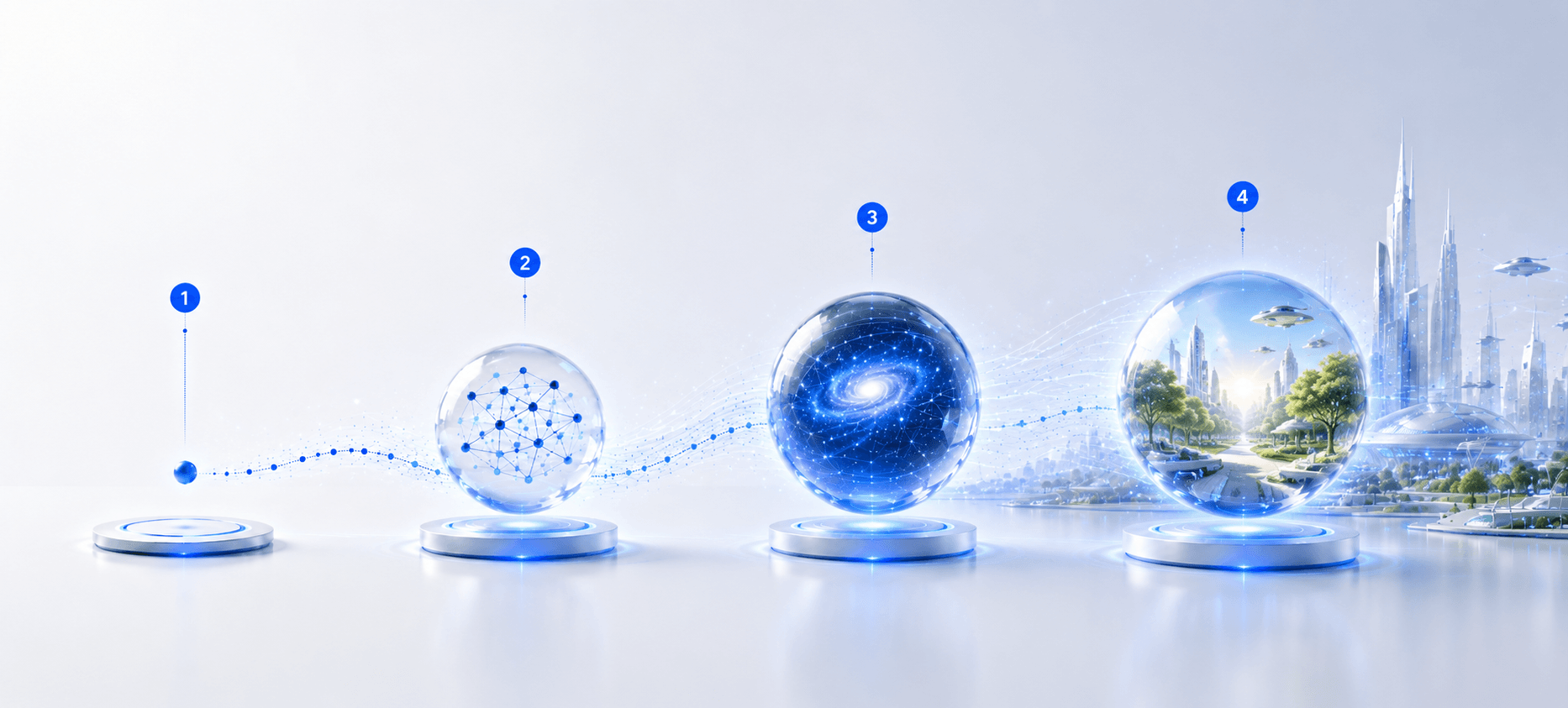
The Fourth Point
Well... here we are. We have finally reached the fourth and the last article of this series.
This article is different from the previous ones. Before, I was talking mostly about the next few years and about changes that I believe we will see during our lives. This time I want to go much further. Much further than any of us will ever see.
This is the fourth point. The point that is somewhere far away on the horizon.
Maybe five hundred years from now. Maybe one thousand. Maybe even longer. I don't know. Nobody knows. What I do know is that it is outside our lifetime, so none of us will be able to check whether I was right or wrong.
So why should we even talk about something so far away?
Because I believe it helps us understand what is happening today. If you can roughly see where the road is going, it becomes much easier to understand why the first few steps look the way they do.
Everything in this article is my personal opinion. These are not facts. They are not scientific predictions. They are simply the conclusions I came to after thinking about AI for a long time. You may completely disagree with me, and that is perfectly fine.
I simply want to invite you into my way of thinking.
It Was Impossible... But They Did It
If I had to describe this entire article with one sentence, it would be this:
It was impossible... but they did it.
For me, this sentence completely changed the way I look at the future.
Before modern AI appeared, I honestly believed that something like ChatGPT would not exist during my lifetime. I thought computers would become better every year, but I never expected a machine that could understand questions, write code, explain ideas and hold a conversation that feels so natural.
I was wrong. The impossible happened.
That experience changed something in me. Today, whenever I hear someone say, "This will never happen," I immediately remember that feeling. I remember saying almost the same thing myself.
Of course, today's AI is still far from perfect. It makes mistakes. Sometimes very simple ones. It still lacks a huge amount of practical knowledge that exists only inside companies and inside the minds of experienced professionals.
I talked about this in the previous article. The internet contains an incredible amount of information, but it is still only a small part of all human knowledge. A lot of experience has never been written down. It still lives inside people's heads.
Because of that, today's AI is still relatively weak compared to what it may become one day.
But there is one thing we should not ignore.
Even in this early stage, it has already shown us that many things we considered impossible can suddenly become possible.
That is why I believe the future will surprise us many more times.
So let's make one assumption for this journey.
Whenever we think, "No, this cannot be done," let's remember that sentence one more time.
It was impossible... but they did it.
Now let's see what this idea could mean for different professions.
Looking at Professions
I obviously cannot talk about every profession in the world. There are simply too many of them.
Instead, I want to choose a few examples. My goal is not to describe every job in detail, but to show the direction I believe we are moving towards.
Some examples may sound more realistic than others. Some may even sound impossible today. That is completely normal.
Remember, this article is about the fourth point.
Accounting
Let's start with accounting.
I believe accounting may be one of the first professions that changes dramatically. Maybe not tomorrow, maybe not next year, but I think it will happen sooner than many people expect.
Why hasn't it happened already?
In my opinion, the answer is quite simple. A large part of accounting knowledge is still hidden inside institutions, tax offices, companies and internal procedures. Much of that experience is not publicly available, so AI cannot learn from it yet.
That is very different from software development, where millions of examples are publicly available. Programming languages, documentation, tutorials and open-source projects gave AI an enormous amount of material to learn from.
Accounting is much more closed.
But I don't believe it will stay that way forever.
Sooner or later, more data will become available. Better models will appear. Local tax systems will be understood much better. AI will slowly learn how accountants think, just like it learned how programmers think.
When that happens, I think most everyday accounting work will become automatic.
Imagine simply writing:
"I started a company. I hired two employees. I bought a new computer. What should I do next?"
Instead of searching through dozens of websites, reading complicated regulations or paying someone just to prepare basic documents, AI could explain everything step by step in your own language.
Then it could prepare every document for you. It could write every letter. It could fill every form. And it could probably write those documents better than most people, because it would learn from millions of previous examples.
The same technology could also help tax offices. Large amounts of data are almost impossible for humans to analyse efficiently, but they are exactly the kind of task computers are good at.
Eventually, I believe both sides will use AI.
For some time it may look like a technological race. Better AI helping citizens, better AI helping governments.
But when I look at the fourth point, I think even that competition disappears.
Why?
Because I believe money itself will slowly lose the role it has today.
I know this may sound strange right now, and I will come back to this idea later in the article series. For now, I simply want to leave that thought here.
If money eventually becomes much less important than it is today, then accounting changes as well. Taxes, reporting and financial administration become something completely different from what we know now.
That future is still very far away.
But when I look at the fourth point, I think this is one of the directions humanity may eventually follow.
Law
Another profession I often think about is law.
At first glance, it may look like lawyers are much safer than programmers. Many people believe AI will never understand law because every case is different.
I used to think something similar. But after spending a lot of time thinking about it, I slowly changed my mind. The main reason is almost the same as in accounting.
Today, a huge amount of legal knowledge is still hidden. Court decisions, internal documents, procedures and years of professional experience are spread across thousands of institutions and organisations. Much of this knowledge is simply difficult to access.
That means AI still cannot learn from everything. But I don't believe this will stay the same forever.
As more legal information becomes digital, searchable and connected, AI will slowly become better at understanding how the legal system works.
I don't think this will replace every lawyer. At least not for a very long time.
Complex cases will still need experienced people. Difficult negotiations, unusual situations and important decisions will still require someone who understands much more than just the law itself.
But everyday legal problems are different.
Imagine buying a new washing machine. It breaks after two weeks, but the shop refuses to repair it or give you your money back.
Many people simply give up. Not because they are wrong. Because they don't know what to do and how to communicate properly
Finding the correct law is difficult. Writing a formal letter is difficult. Understanding the procedure is difficult.
For many people, hiring a lawyer for a relatively small problem simply doesn't make financial sense.
I believe AI will change this.
You will simply describe your problem in your own words. It will explain your rights. It will prepare every document. It will tell you exactly where to send it. It will explain what usually happens next.
Maybe it won't solve every case. Maybe it will only be right 70% or 80% of the time in the beginning.
But even that changes everything.
Suddenly, millions of people who cannot afford legal help will have access to something much better than searching random websites for hours.
For me, this is one of the biggest advantages of AI. It doesn't only make experts faster.
It also gives ordinary people access to knowledge that was previously too expensive or too difficult to reach.
Why Law Looks Similar to Programming
There is another reason why I believe law will change so much.
The more I think about it, the more I see similarities between programming and legal systems.
Both are built on rules. Every word has a meaning. Every sentence can change the final result.
One condition leads to another. One rule depends on another. A small change in one place may completely change the outcome somewhere else. Programming works like this. Law works like this too.
When ChatGPT appeared, many people were surprised that it could write software.
Why?
Because software development is built on structured rules. Programming languages have syntax. Documentation explains how everything works. Millions of examples exist on the internet.
AI learned those patterns surprisingly well. I believe legal systems are also based on patterns. Different patterns. More complicated patterns. But patterns nevertheless.
That is why I believe AI will become much better at legal reasoning than many people expect today.
Again, I may be wrong.
But I remember one sentence.
It was impossible... but they did it.
Every time I think something cannot happen, that sentence comes back to me.
Maybe one day we will look at legal assistants the same way we now look at AI programming assistants. Today it sounds ambitious. One day it may become completely normal.
Medicine
Medicine was probably the hardest profession for me to think about.
For a long time, I believed doctors would never be replaced. I kept coming back to the same question. How could a machine ever replace the experience and precision of a surgeon?
And honestly...
I still don't know the answer.
But every time I reached that conclusion, another thought appeared in my head.
"It was impossible... but they did it."
That sentence forced me to look at the problem from another angle. Maybe the question isn't whether it is possible today.
Maybe the question is whether it will still look impossible in a few hundred years.
I don't think so. I believe robotics will continue improving. New materials will appear. Better sensors will appear. Mechanical precision will continue to improve.
Eventually, robotic hands may become as accurate as human hands. Maybe even more accurate. That doesn't mean doctors disappear.
Someone will still need to design these systems, improve them and supervise them. But I believe the way medicine works will slowly change.
The biggest change may not even happen in the operating room.
I think it will happen much earlier. During diagnosis. Imagine simply walking into a medical centre. Your body is scanned from head to toe.
Within minutes, the system knows what is happening inside your body. It compares your results with billions of previous cases. It notices problems long before you feel any symptoms.
It doesn't only tell you what is wrong today. It may also tell you what could happen five or ten years from now.
That sounds futuristic.
But when I look at the fourth point, I think it becomes much easier to imagine.
The human body also follows rules. It is an incredibly complex biological system.
The more we understand those rules, the better AI will become at recognising patterns that humans simply cannot see.
I don't believe medicine will stop evolving. Quite the opposite.
I think we will understand more about ageing. We will understand more about diseases. We will find better treatments.
Some illnesses that are difficult to treat today may become routine in the future.
Others may disappear completely. Because of that, I also believe people will live longer.
History already shows this trend.
Over the last centuries, life expectancy has continued to increase. I don't see a reason why that progress should suddenly stop.
Maybe one day we will slow ageing itself. Maybe damaged cells will be repaired instead of simply treated.
Maybe organs will be replaced before they fail. I don't know exactly how it will happen.
But I believe medicine will look completely different when we finally reach the fourth point.
Cars
Now let's leave medicine for a moment and simply walk outside.
What do we see?
We see streets full of cars.
And I honestly believe they will still be there hundreds of years from now.
Many science fiction movies showed us flying cars. Maybe that will happen one day. Maybe not. Personally, I don't think that will become our everyday reality.
I think people will still drive or rather travel in vehicles that look quite similar to today's cars.
The biggest difference will not be the vehicle itself. It will be everything around it.
The fuel may change completely. Maybe it will come from water. Maybe from another renewable source that we haven't discovered yet. I don't know what it will be, but I believe we will eventually move away from fossil fuels.
What interests me even more is something else.
I think cars will slowly stop being a symbol of wealth.
If we look back just twenty or thirty years, we can already see this happening. More and more people can afford a car. It is becoming a normal part of life instead of a luxury.
I believe this trend will continue. One day, almost everyone will be able to have the car they need. Not because salaries become incredibly high. But because producing cars becomes much cheaper.
I don't literally mean giant 3D printers making cars.
I simply believe manufacturing will become so efficient that producing a new vehicle will no longer be a difficult task.
When that happens, something interesting may also disappear.
Today's expensive brands.
Design Over Brands
This may be one of the predictions people disagree with the most.
I believe brands like BMW, Mercedes or Audi will slowly lose the role they have today.
Not because they build bad cars.
But because there is a natural limit to how much better a car can become.
Think about it.
A car has one main job. Take you safely and comfortably from point A to point B.
Of course, you can always improve something. Better lights. Better suspension. Better software. Better materials.
But sooner or later those improvements become very small. At that point, people will stop paying mainly for engineering. They will start choosing based on something else.
Design.
Imagine walking into a showroom in the future. Instead of choosing between five manufacturers, you simply choose the style you like.
Maybe you want something elegant. Maybe sporty. Maybe futuristic.
Or maybe you simply ask AI:
Create something that looks modern, but not too aggressive. I want it to feel calm.
A few minutes later you see several proposals. You change the headlights. You change the rear lights. You make the roof slightly lower. You adjust the colour.
Eventually you create a car that nobody else has.
And if next year you decide you want something different?
You simply change it.
That may sound strange today, but I think people enjoy change much more than ownership.
I see this everywhere.
Someone buys a new phone. A few years later they want another one. Someone buys a house. After some time they want another layout. Someone loves one car brand for years. Then suddenly they become interested in another one.
I don't think this happens because the previous product became bad.
I think it happens because people naturally enjoy experiencing something new.
That is why I believe future factories may become much more flexible.
Instead of producing one million identical cars, they may produce one million different ones. AI will generate the design. Robots will build it.
And if you want another design a year later, your old car may simply be recycled into a new one. Its materials become the next car.
The process starts again.
To me, this feels much more natural than producing millions of identical vehicles forever.
Will Cars Still Matter?
People often ask another question.
If everyone can have almost any car, won't cars become boring?
Actually...
I think the opposite will happen.
Cars will become less important as status symbols, but they will become more personal. Some people simply want reliable transport. Others love beautiful design. Some enjoy driving itself. Others only care about reaching their destination.
I don't think human nature will change.
Different people will continue to enjoy different things. That is exactly why I don't believe we will all end up driving the same car.
Technology may become similar. Materials may become similar. Manufacturing may become similar.
But people will remain different.
And because of that, AI will probably create thousands of different designs instead of one perfect design.
In the end, I don't think cars will disappear.
I think they simply become another everyday object. Just like smartphones slowly became. They are still important.
But they no longer define who we are. No brands, no luxury meaning. Simply A to B.
Restaurants
Now let's leave cars behind and continue our walk.
Imagine walking into your favourite restaurant.
What do you see?
Today you see waiters, chefs, cashiers and people working hard to make everything run smoothly.
I believe this will slowly change.
In the future, I think most restaurants will be operated almost entirely by robots. That doesn't mean every restaurant.
There will always be places where people go because they enjoy being served by another person. Some restaurants will keep that atmosphere on purpose. It will become part of their identity.
But I believe those places will become the exception rather than the rule.
Most of us don't visit a restaurant because we want to talk to the waiter. We go because we are hungry.
We want good food. We don't want to wait too long. And we want everything to work smoothly.
If a robot can do all of that better, faster and more consistently, I think most people will naturally choose that option.
I know some people will immediately say,
But I like human interaction.
And I completely understand that. I thought about this many times ... .many…trying to find an answer can it be the crucial objection, and yes, I know the exact answer to such an objection.
I don't think we actually look for conversation with a waiter.
I think we look for good experiences, happiness.
Today those experiences sometimes happen in restaurants because that is one of the few places where people naturally meet.
But in the future I believe there will be many other ways to spend time together.
If my friends invite me to the beach...or my family wants to go somewhere...or there is another activity I enjoy more...
My brain will choose that instead of communicating with waiters.
The restaurant simply becomes the place where I eat. Nothing more.
That is why I believe efficiency will become much more important than human service.
Everything Works Together
There is another reason why I think this will happen.
Technology never develops alone. Everything moves together. Robots become better. Kitchen equipment becomes smarter.
Food preparation becomes easier to automate. Even recipes may slowly adapt to make automation simpler without reducing quality. This is something I noticed while thinking about many industries.
Technology improves.
But the world around that technology also changes. Let's take kitchens as an example.
If one type of cabinet is difficult for a robot to repair, maybe future cabinets will simply be designed differently.
Not because humans cannot repair them. But because making them easier to repair benefits everyone.
I think restaurants will evolve in exactly the same way. Kitchen equipment. Cooking processes. Food storage. Cleaning. Everything will slowly adapt to automation.
The result?
You walk into a restaurant. Your favourite meal is already suggested because the system knows what you usually order. It also knows if you prefer less salt. Or more spicy food. Or a larger portion because you skipped lunch.
The system already knows how busy the restaurant is. It knows exactly how long your order will take. There are no surprises.
Everything is predictable. Everything simply works.
Personally...
I think I would enjoy that.
Shopping
Shops may change even faster.
In fact, I think we will still see some of these changes during our own lives.
Some of them are already starting to appear.
Imagine entering a grocery store. You take what you need. Then you simply walk out.
No queues. No checkout. No scanning products. No waiting.
Everything happens automatically.
To me, this feels like a very natural direction.
Take vegetables as an example.
Instead of weighing them yourself, every container could already know exactly how much food it contains.
You take three tomatoes. The system immediately knows how much weight disappeared from this general tomato box, so, that's 3 your tomatoes. Then, you take onion, potato etc. It updates your basket automatically.
When you leave the shop, payment is already ready. You simply confirm it and go home.
Honestly...
I am a little surprised that this is not already common everywhere.
But nowadays I no longer ask,
"Why doesn't this exist?"
I usually ask,
"When will it appear?"
That is a very different question.
And I think AI changed the way I ask it.
Movies
Let's finish this part with entertainment. I also believe AI will change the way we watch films and TV series. Not because people suddenly forget how to make movies.
But because creating stories will become much easier.
Today you open Netflix and choose from thousands of existing titles.
Now imagine something different.
You tell AI:
I want a detective story with a little comedy. I want it to take place on a ship. Surprise me with the ending.
Instead of searching for a film...
The film is created just for you.
Maybe not tomorrow.
But when I think about the fourth point, I believe this becomes possible. The AI asks you two or three questions. Who should be the main character? Do you want something serious or funny? Should the ending be happy or unexpected?
Then it starts creating.
Maybe the whole series is ready in an hour.
Or maybe something even more interesting happens. The story doesn't exist at all until you press Play. Each episode is generated while you are watching it. The next scene depends on everything that happened before. The AI keeps writing the story in real time.
To me, this sounds much more exciting than watching the same fixed series as everyone else.
You may even ask for something completely unusual.
Maybe you want an old-fashioned detective story, but with one completely unexpected twist.
Maybe you want a comedy mixed with science fiction. Maybe you want a story that nobody has ever seen before. I believe AI will eventually be able to create that. Not because it is more creative than humans.
But because it can instantly combine millions of ideas in ways that would take people much longer.
And honestly...
I think I would be curious enough to press Play.
What Will People Do?
At this point, a very natural question appears.
If AI cooks...If robots build...If stores run themselves...If cars are produced automatically...
Then what will people actually do?
To be honest, I think this is the question that worries people the most. Whenever someone hears about AI replacing jobs, this is usually the first thing they ask.
What will be left for us?
I believe the answer is much simpler than it seems.
People will simply live)))
I know that sounds almost too simple.
But think about it for a moment.
Most of us spend a large part of our lives working because we have to. Not because it is our biggest passion. Of course, there are people who truly love their jobs. I know many of them. I personally))) for example.
But I also know many people who would gladly spend more time doing something else if they had that opportunity.
Some would travel. Some would paint. Some would write books. Some would compose music. Some would simply spend more time with their family or mix of those.
I don't think people are lazy by nature.
Actually, I believe the opposite. People like creating things. People like learning. People like solving problems.
The problem is that very often we don't have enough time.
That is why I don't believe humanity will become bored.
Give someone one or two weeks of complete freedom and they will probably enjoy doing nothing.
Give them six months.
Sooner or later they will start looking for something meaningful. That is simply how we are built.
We are curious. We like discovering new things. We like improving. And we like creating.
I don't think AI changes that.
I think it gives us more time to do it.
Finding Ourselves
Imagine a young person who always wanted to become a composer.
Today they may never even try. Life gets in the way. Bills need to be paid. There is work.
There are responsibilities.
Years pass.
One day they realise they never gave their dream a real chance. I think many people live like that.
Not because they made a mistake. But because life simply leaves very little free time.
Now imagine a different world. AI takes care of many everyday tasks.
Robots build houses. They prepare food. They transport goods. They clean. They manufacture products.
Suddenly people have something they never had enough of.
Time.
Some people will learn music. Some will write stories. Others will start small businesses simply because they enjoy building something. Some will become designers. Some will invent completely new hobbies that don't even exist today.
And honestly...
I think many hidden talents will finally have a chance to appear.
There are probably thousands of incredible artists, writers, engineers and inventors who never discovered what they were capable of.
Not because they lacked talent. Because they lacked time.
That is one of the biggest opportunities I see in AI. It doesn't only make people faster. It gives people back time.
And time is probably the most valuable thing we have.
A Different Kind of Work
Does that mean nobody will work anymore?
No.
I don't believe that at all. I think work itself will change. Instead of working because we must, many people will work because they genuinely enjoy it.
Some people love designing cars. Let them design.
Some people love architecture. Let them create buildings.
Some enjoy programming. Others enjoy teaching. Others enjoy gardening.
I don't think AI removes those passions. If anything, I believe it allows more people to discover them.
That is a future I would actually like to see.
Closing Thoughts
So, after looking at accounting, law, medicine, cars, restaurants, shops and entertainment, what conclusion do I come to?
I believe AI will eventually touch every profession.
Not tomorrow. Not all at once. And not always in the same way.
Some jobs will change faster. Others much more slowly. But I don't think any profession will remain completely untouched.
That may sound scary. Sometimes it scares me as well. Change always brings uncertainty.
We don't know exactly what comes next. We don't know which new opportunities will appear. We don't know which old habits will disappear.
But when I look at the bigger picture, I don't see a future that becomes worse.
I see a future that becomes different.
And maybe...
Just maybe...
A little better or even not a little as for me
The interesting thing is that all of these examples have something in common. They all lead to one idea. Technology doesn't only make machines better. It gives people something much more valuable.
Time.
And that brings me to the next part of this journey. Because I believe humanity has already experienced something very similar once before.
It happened long before artificial intelligence.
It started with an invention that completely changed the world.
The internal combustion engine.